
The Ultimate Guide to Princess Cut Diamonds
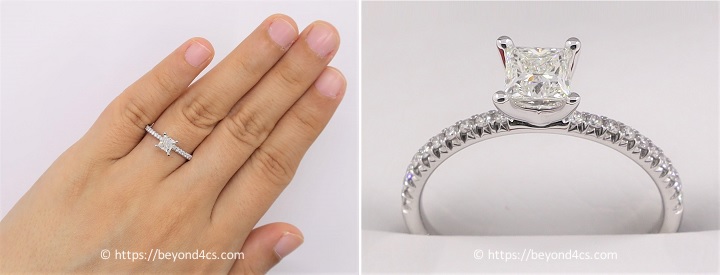
My wife wearing a princess cut pave diamond engagement ring ($2,000).
The princess cut is the 2nd most popular shape after the round diamond. It was first introduced to the world in the 1960s by a gentleman from London named Arpad Nagy. Back then, the princess cut was derived as a variation of another cutting style called the “profile cut”.
A. Nagy wanted to create a cut that could make efficient use of rough stone with less wastage and one that could emulate the brilliance and fire of a brilliant cutting style. Within a short span of a few years, leading cutters poured in huge research efforts to perfect the design and evolved it into what we call today as the square modified brilliant.
With a market that is over-saturated with rounds, the princess cut offers a unique looking option for people who would like to stand out. In this write up, you will discover the insider tips to choosing a bright, sparkly diamond and find out how you can save money when buying your engagement ring.
In fact, I’m also going to reveal full details of how I bought a gorgeous looking pave engagement ring and show you how an ideal cut princess diamond looks like in real life. Let’s get started…
Here is a list of topics we will be covering:
- Recommended Proportions for Princess Cut Diamonds
- Length to Width Ratio – Keeping It Square
- How Much Does a Princess Cut Diamond Cost?
- Recommended Color Grades for Princess Cut Diamonds
- What Are the Best Clarity Grades for Princess Cut Diamonds?
- 3 Things You Need To Beware Of When Selecting Princess Cut Diamonds
- How I Bought a Beautiful Pave Princess Cut Diamond Ring
- Best Engagement Ring Settings For Princess Cut Diamonds
- Summary And Recap: Best Places to Buy a Princess Cut Diamond Ring
Recommended Proportions for Princess Cut Diamonds
Unlike round diamonds, princess cut diamonds have different facet patterns and do not have an assigned cut grade in GIA’s grading reports. This makes it hard for an inexperienced shopper to assess a princess cut diamond’s light performance.
However, there are some proportion ranges that you can use as a guideline to select well-cut diamonds. This is compiled based on my experience in dealing with super ideal cut princess diamonds and you can check it out below:
| Excellent | Very Good | Good | Fair/Poor | |
|---|---|---|---|---|
| Table % | 63% – 69% | 57% – 75% | 53% – 82% | Outside Ranges |
| Depth % | 69% – 76% | 60% – 78% | 58% – 80% | Outside Ranges |
| Polish/Symmetry | Excellent – Very Good | Good | Outside Ranges | |
| Length to Width (Square) | 1.00 – 1.02 | 1.00 – 1.04 | 1.00 – 1.05 | Outside Ranges |
| Length to Width (Rectangle) | 1.5 – 1.75 | 1.76 – 1.85 | 1.86 – 1.99 | Outside Ranges |
| Girdle Thickness | Thin – Slightly Thick | V. Thin – Thick | Outside Ranges | |
| Culet Size | None | Very Small | Small | Outside Ranges |
* Note: The proportions table should be used as a reference only. You should use tangible data like videos and ASET images to help you make a final decision. Never go below very thin for girdle thickness or you run the risk of chipping the diamond easily.
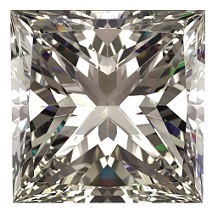
From experience, princess diamonds require higher depth percentages between 69-76% in order for it to have excellent light return properties. The table size of the princess diamond should not be too large (best range: 63-69%) as it affects fire and colored light dispersion properties.
To give you some idea of what a well cut princess diamond looks like, I’ve handpicked 2 examples below with top notch light performance and scintillation patterning. Feel free to click on the images to interact with the video listings for yourself…
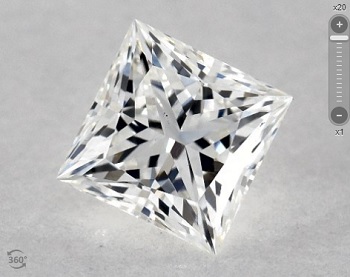
0.58ct G VS2: AGS #1040101544004
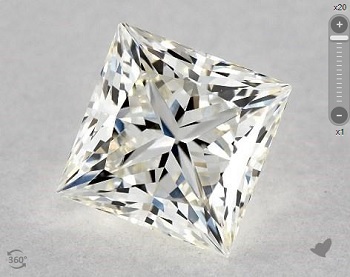
1.028ct J VVS2: AGS #104101544014
Length to Width Ratio – Keeping It Square
The princess diamond is traditionally a square cut made of 4 equal sides. In my opinion, the ideal length-to-width ratio should be within the range if 1:1 to 1:1.02. Anything beyond a 1:1.05 would cause the diamond to look “off-square” to the eye.
Here’s a reference diagram that compares the outlines of different l/w ratios.
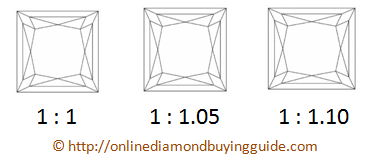
Most people prefer a squarish look instead of a slightly rectangular appearance. However, if you prefer a slightly rectangularish princess cut, that’s perfectly fine as well and it is what you like most that matter.
How Much Does a Princess Cut Diamond Cost?
Compared to round diamonds, the prices of princess cut diamonds are generally 25-35% lower because of the higher yield from the rough diamond cutting. This is due to the pyramidal shape of the princess diamond which results in minimal weight loss from an octahedral rough stone during polishing.
Out of all the different fancy shape diamonds, princess cuts are the cheapest per carat and this means you can get a bigger bang for your buck. Below, I’ve compiled a price comparison table using 1ct princess diamonds with different color and clarity ratings.
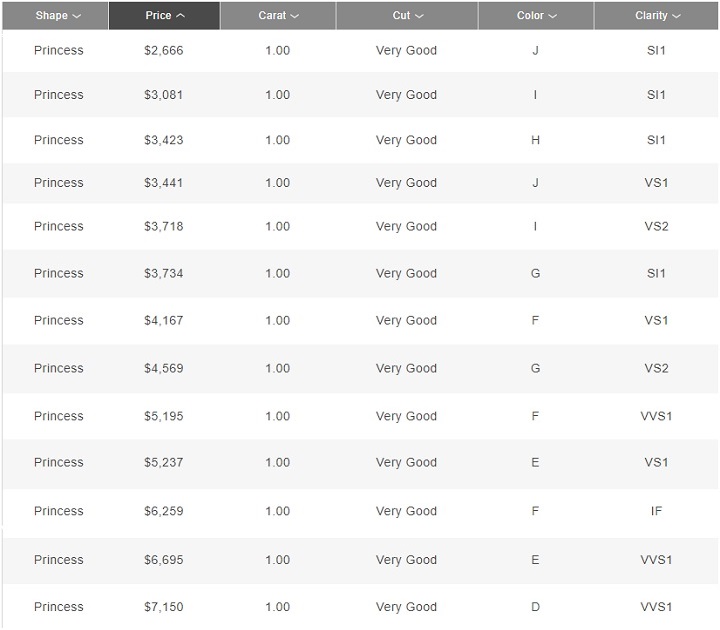
Price chart comparison of GIA certified 1ct princess shape diamonds.
From the table above, you can see that the price of a 1 carat princess shaped diamond can range anywhere between $2,500 to $8,000. This price variation is highly dependent on rarity factors like color and clarity.
Here, I want to highlight a common mistake that beginners make when they assume that a D/IF diamond will have better sparkle and brilliance compared to a lower color/clarity diamond.
In fact, if you chose a well cut G/VS2 princess diamond at nearly half the price of a D/IF diamond, you won’t be able to see any visual differences in the face up view between these 2 diamonds.
So, if you are a practical person and don’t need the symbolic IF clarity rating, then choosing a near colorless and eyeclean diamond will help you save a lot of money!
Recommended Color Grades for Princess Cut Diamonds

Face up appearances of D to K color diamonds graded by GIA.
When it comes to buying diamond jewelry on a budget, the princess cut is a good choice for a balance of beauty and cost. This is because the brilliance and fire exhibited by a well-cut princess can help mask inclusions and hide body color.
As a result, you can go low on color and clarity grades without seeing any differences to the unaided eye. For people who are looking to get a cool, icy white appearance in their diamond ring, I would recommend a G or higher rating.
Here, I do want to point out that the choice of color is entirely subjective and up to personal preferences. If you are buying a yellow gold setting or prefer a warm looking diamond appearance, it is perfectly fine to buy a J or K color diamond. Plus, you get to save money too!
What Are the Best Clarity Grades for Princess Cut Diamonds?
Well cut princess diamonds display good scintillation and brilliance that can help cover up flaws in the diamond. Now, I’m a practical person and I don’t see a need to pay the premium for a high clarity grade that doesn’t provide any visual benefits to the naked eyes.
I recommend buying diamonds in the SI1 or VS2 clarity range to save money as long as the diamond is eyeclean (inclusions cannot be seen with naked eyes). The caveat here is that you need to purchase from a retailer that provides photos or videos of the actual diamond to help you assess eyecleanliness.
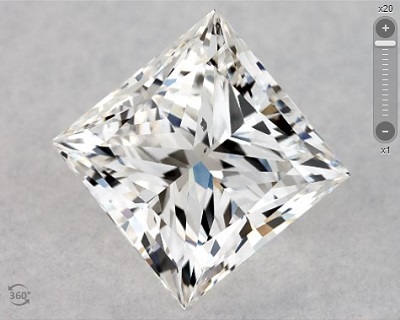
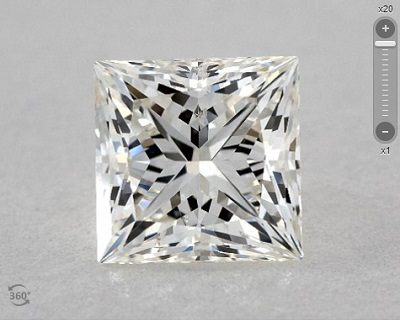
Check out these 2 examples of SI1 diamonds below and click on the images to interact with the video listings. Are you able to quickly tell which is eyeclean and which isn’t?
3 Things You Need To Beware Of When Selecting Princess Cut Diamonds
#1 – The 4 Pointed Corners Are Vulnerable Areas
When setting a diamond, the 4 corners of a princess cut diamond are prone to chipping due to the lower mechanical strength at the points. In general, I would avoid princess cuts with severe inclusions located near the corners because they can create weak points in the crystalline structure and cause durability issues…
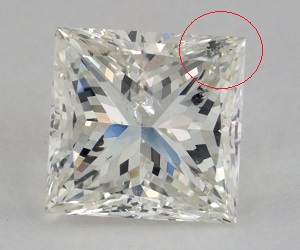
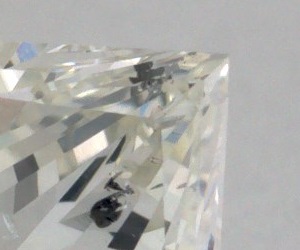
This I1 princess cut has a crystal inclusion that poses a significant danger for durability.
#2 – Beware of Weight Retention Tricks Employed by Cutters
In the profit-driven industry of diamond cutting, the majority of polished diamonds are cut to preserve the maximum weight from the rough. This is usually done at the expense of cut quality and better sparkle.
In princess cut diamonds, the tell-tale signs of diamonds cut with weight retention techniques are table percentages near or higher than 80% and very thick – extremely thick girdles.
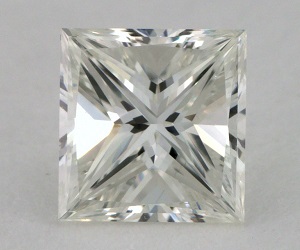
This hideous looking diamond has uneven-sides and an enormous table size of 83%.
The problem I personally have with such diamonds is that their optical performance had been compromised for higher carat weight. For example, having a table size that is too large will result in a significant reduction of fire.
Excessively thick girdles are also something I would avoid because they lock in carat weight at the girdle area which can’t be seen once the diamond is mounted. This means that you get a significantly smaller looking diamond despite paying more for carat weight!
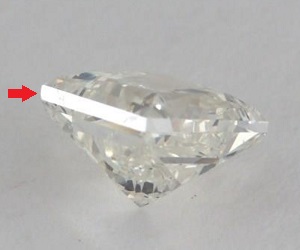
Arrow depicting weight hidden in profile view with an extremely thick girdle.
#3 – Poor Outlines And Shape Appeal Issues You Should Avoid
Did you know that princesses can come in all sorts of shapes and outlines?
Sadly, the market is flooded with a lot of badly cut diamonds with poor visual appeal and light performance. Below are some of “bad” examples of shapes and outlines that princess cuts can come in.
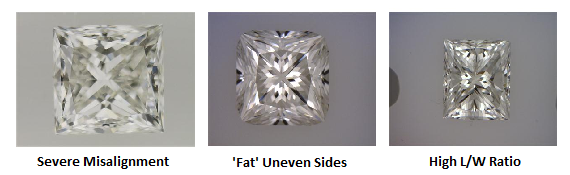
One of the most common mistakes people make when buying fancy cuts is to buy sight unseen or based solely on a grading report.
This is because the grading report alone will never tell you how the diamond looks like in real life. To avoid such problems, I highly recommend that you work with vendors that offer visualization technologies so that you know what you are getting.
How I Bought a Beautiful Pave Princess Cut Diamond Ring
I’ve recently purchased a princess cut pave diamond engagement ring from James Allen simply by following the guidelines I stated above.
With a budget of $2,000, I was able to cherry pick the best diamond for light performance using the video listings and ASET data found in the AGS grading report.
Here are the full details of the ring I put together by combining the loose diamond and ring setting design:
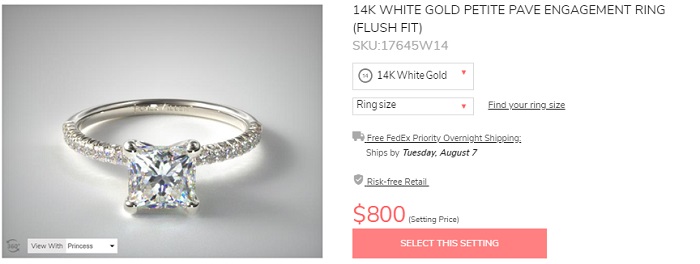
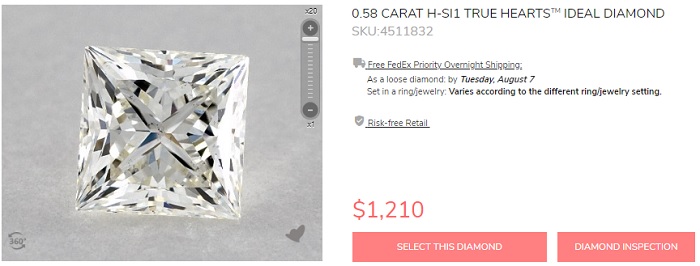
If you do some simple math, the cost of the engagement ring totals up to $2,010 and that’s a really affordable price! And the thing is, the craftsmanship of the ring is superb and it offers great value for money.
In fact, I also did a review of the ring and you can check out some of the close up pictures of their workmanship below.
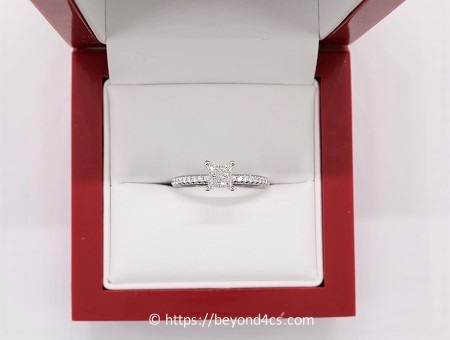
Overview of the engagement ring in a cherry red ring box.
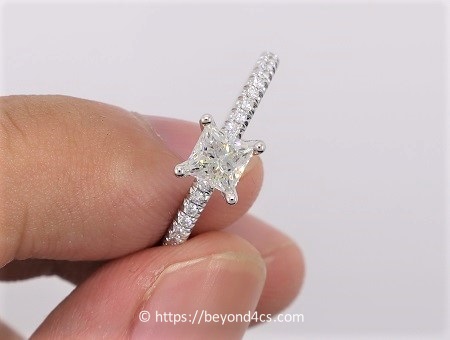
Close up view of prongs that are neatly placed.
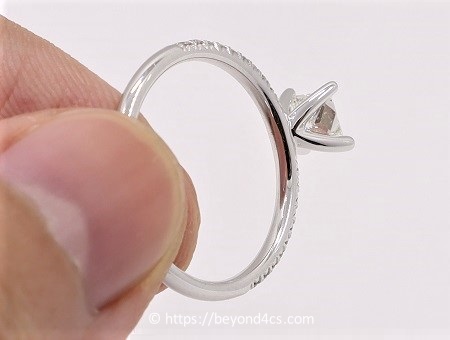
Finishing of the ring is superb even in inner surfaces.
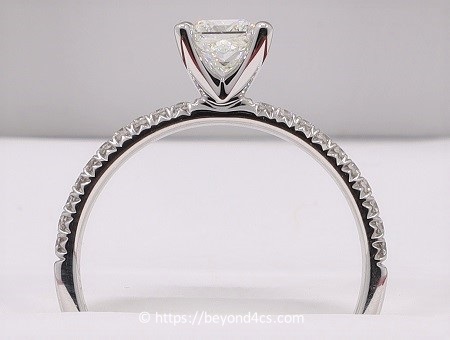
Pave is highly streamlined and neatly placed to perfection.
I’ve also included a video review of the pave ring that also shows how the princess cut diamond performs in real life. Watch it in full below:
Best Engagement Ring Settings For Princess Cut Diamonds
The right setting can maximize the aesthetic beauty of the engagement ring and also provides security to protect the princess cut diamond. Here are some of my favorite designs and I hope it can offer some ideas to help you to find your dream ring.
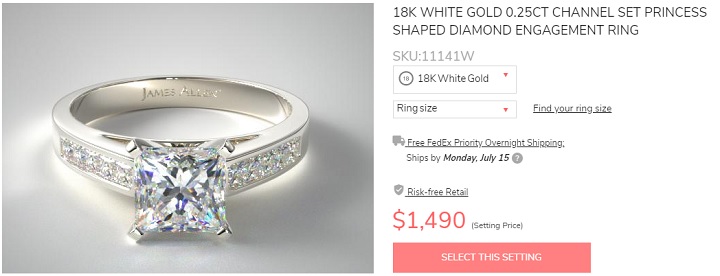
This channel set design features 5 carefully matched square cut melees to accentuate the center stone.
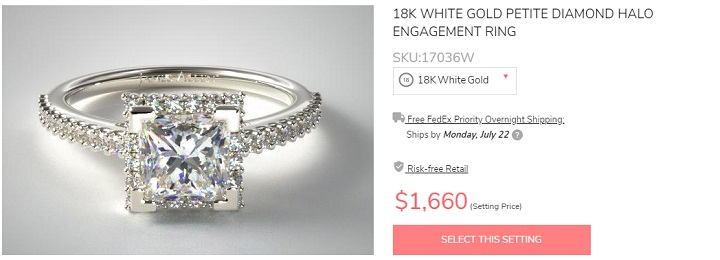
A contemporary design that features a single row of halo diamonds and a V-bar open undergallery.
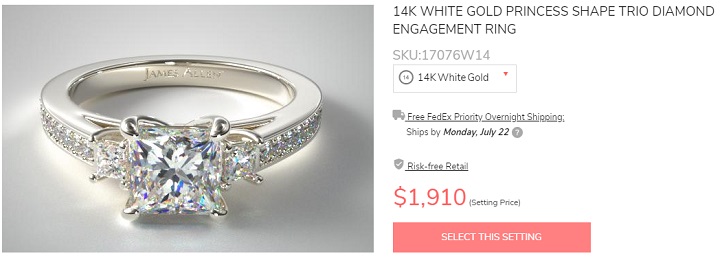
Breathtaking and full of sparkle, this trio diamond ring design is elegant and stylish to look at.
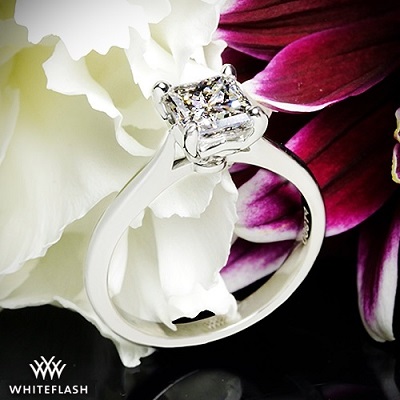
This beautiful 4 prong setting has sleek and smooth looking shanks that give off a classy vibe.
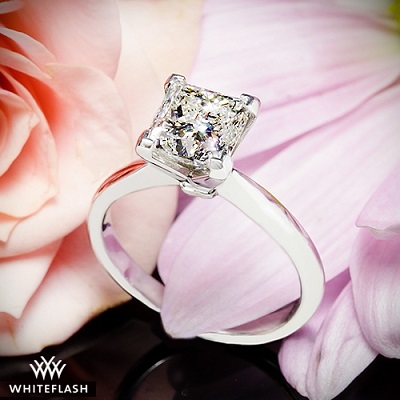
This 4 prong v-tip head provides superb protection and doesn’t overwhelm the center stone’s appearance.
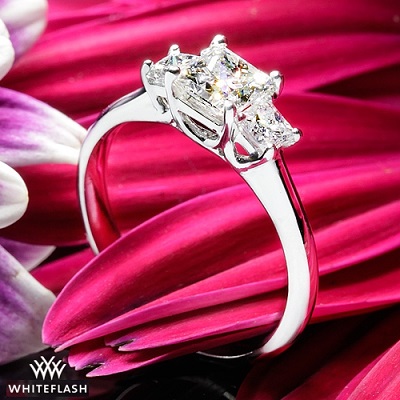
This classy 3 stone trellis engagement ring features intertwining prongs that hold the diamonds in place.
Summary And Recap: Best Places to Buy a Princess Cut Diamond Ring
To recap, here are my recommended guidelines for buying a princess cut diamond:
Depth: 69% to 76%
Table: 63% to 69%
Polish/Symmetry: Very Good or Excellent
Length to Width Ratio: Within a range of 1.00 to 1.02
Color: G or better
Clarity: SI1 or better
As I said earlier, these proportions and parameters should only serve as a guideline to help you narrow down your selections. In order to make an educated purchase decision, you will need to rely on tangible data like videos and ASET images.
That is why a reliable vendor is so crucial when it comes to buying a diamond ring. The best places to shop for princess cut diamonds are James Allen, White Flash and Brian Gavin as they provide HD videos and cut performance data to help you make the educated decisions.
These vendors also offer superb craftsmanship on their rings and have highly competitive prices. On top of that, they are customer orientated and have generous policies that ensure you shop 100% risk-free.
I hope this article has given you useful insights and if you have any questions or require help to pick out a diamond, drop me an email or leave a comment below. Good luck!
Related Articles
About The Website:
Leave A Comment
Latest Posts From Our Blog


Join Us On Social Media!



Visit The Gallery For Ideas!

24 Comments
I’m looking for a 1.5 carat sized princes cut diamond engagement ring for an upcoming proposal. Do you know of any diamond importers with great wholesale pricing in the Ohio region?
Also, can’t you teach me how to choose a princess cut diamond that does not have certifications? I have a local dealer here that sells both certified loose diamonds and those without. They are having a sale on those stones that do not have certifications. The prices on those look really tempting and I’m not sure whether any of those are ideal choices.
Sorry for any bad English. It is not my native language.
I think you are taking an extremely dangerous approach in your shopping process. First of all, “wholesale” pricing in the diamond industry don’t exist for consumers. It’s a marketing scam (just like the big banners that scream “princess cut rings sale”) used to draw in unsuspecting consumers with the false impression of preferential pricing.
Read this: https://beyond4cs.com/engagement-ring/beware-of-cheap-diamond-deals/
I would NEVER buy such a large sized diamond (1.5 carats) without proper grading reports to accompany them (i.e. GIA/AGS). Often times, they are misrepresented. I advice sticking with AGS ideal princess cut diamonds and you can find a couple of companies that deal with these beautiful stones here:
https://beyond4cs.com/reviews/whiteflash/
https://beyond4cs.com/reviews/brian-gavin-diamonds/
I’m torn between the choice of round vs princess cut diamonds. My fiancee had given me the option of choosing one for myself with a budget of $8,000. I had seen a number of engagement rings in a local Jared store and it seems like princess cuts are cheaper by their carat weight.
I compared a 1 carat round vs a 1 carat princess cut diamond in a solitaire setting and noticed that the round looks slightly bigger. Is this due to the depth of the stone? Obviously, I want the largest looking stone for the least amount of money. I can’t make up my mind and would like your advice on which is better: the princess or the round?
It’s true that princess cuts tend to have deep depths. This makes them face up slightly smaller. However, because of the cutting style, polishing princesses tend to have better yields from the rough stones. This is why they are priced lower than a round diamond with similar carat weight. Choosing between a round and a princess is really up to personal preferences. If you are unsure, try to look at more stones and engagement rings in person. This will help you decide which shape your tastes are geared towards.
Hello! Thank you so much for all the helpful information you provided!
Based on what you said, do you consider this diamond to be a good choice?
https://www.jamesallen.com/loose-diamonds/princess-cut/0.71-carat-f-color-vs2-clarity-sku-730104
Also, regarding princess cut diamonds from which size they start to look good?
Thank you!
I would say it’s a decent choice and better cut than the majority of junk out in the market.
Thank you so much for the reply.
As I want to buy diamonds from a retailer in Europe, it has come down to these three choices from blue nile.co.uk. I know it’s not an ideal site to order from, but at least these diamonds include actual photos in the so called gcal reports.
1. http://www.bluenile.com/gr/diamond-details/LD05793753
2. http://www.bluenile.com/gr/diamond-details/LD06086097
3. http://www.bluenile.com/gr/diamond-details/LD05622276
Also, should i take seriously the optical brilliance analysis (white light return) included in these reports?
Again, thank you so much for your help.
I’m not a fan of the GCAL report. https://beyond4cs.com/reviews/blue-nile/signature-diamond/
If you are looking for ideal cut princess diamonds, you probably want to start here:
https://www.whiteflash.com
http://www.briangavindiamonds.com
Hi Paul, Im choosing diamond and I ran up to your site which was very helpful.
So I’m looking at these two princess cut diamonds from James Allen.
https://www.jamesallen.com/loose-diamonds/princess-cut/1.01-carat-e-color-vs2-clarity-sku-825662
https://www.jamesallen.com/loose-diamonds/princess-cut/1.01-carat-e-color-vs2-clarity-sku-823678
I do think the second one is better but more expensive.
By looking at these two, is second diamond worth more paying for than first one by far?
This stone is by far the better cut diamond of the two.
https://www.jamesallen.com/loose-diamonds/princess-cut/1.01-carat-e-color-vs2-clarity-sku-823678
hi Paul, can u give me ur expertise on this princess cut diamond based on the numbers and if it would be a good buy?
Shape: Princess
carat weight: 0.91
color: I
clarity: VVS2
polish: Excellent
symmetry: Very Good
Fluorescence: Medium
l/w/d (mm): 5.10*5.20*3.74
l/w ratio: 1.02
depth %: 73.40
girdle: Thick – Very Thick
table %: 69.00
certificate: GIA
This is not the way to go about buying a princess shaped diamond. Read this: https://beyond4cs.com/buying-diamonds-blind/
Hello Paul. Thank you for providing great information on diamonds. My wife lost her engagement ring and I am looking to replace it. I am looking at the following 2 diamonds. Any thoughts on which one is the better cut?
http://www.whiteflash.com/loose-diamonds/compare.aspx?idnos=3644850,3684602
Both are extremely well cut options. I would recommend going for this stone because of its better edge to edge brightness.
Hello Paul.
Paul, I am interested in buying a engagement ring and diamond separate. Right now I am shopping for a diamond and came up to this one of off the whiteflash website that you reviewed.
http://www.whiteflash.com/loose-diamonds/princess-cut-loose-diamond-3644842.htm
Here is also the item code AGS-104085296003.
Could you please look at it and let me know what you think.
I have to say that your website is full of great information and I have learned a lot just browsing and reading through it. Between a round and princess, which would you choose to buy? What are the advantages and disadvantages between these 2 cuts? Thank you
The diamond you shortlisted is a fantastic option and one that is extremely well cut for light performance. It is eyeclean too. Great find!
Most consumers love the traditional hearts and arrows (round) diamond because of its unparalleled brilliance and sparkle. However, with growing consumer needs and diversifying tastes, variations to the round brilliant cut (each with their own unique properties) had seen a recent resurgence in demand.
While the princess cut has light performance that can be comparable to the round brilliant, it costs significantly less! Due to its better yield from the rough stone, it would please you to know that the price-per-carat weight of a princess cut is the lowest amongst all the shapes.
What makes a princess cut truly unique is that a reflection that looks like a cross is observed when light passes through the diamond. Coupled with 4 pointed corners, superior brilliance and scintillation patterns, these reasons contribute to the appeal that women have for the shape.
The advantage of a round diamond is that they are easier to select compared to princess cut diamonds as they are better established and consistent in their facet structure. At the end of the day, it really depends on your personal preference and what your recipient likes.
Being a relatively new cutting style, most labs (except AGS) do not issue a cut grade for the princess cut. At the point of writing this article in 2013, ongoing research studies and debate are still being carried out by labs about the introduction of a cut grading system for them.
Due to its four-sided shape and variances in facet layouts, diamonds with similar specifications on a grading report will still look different in appearance. With the absence of an objective cut grade, this adds an element of difficulty in choosing a well cut diamond.
When selecting a princess cut diamond for optimum brilliance, you generally want to avoid stones that have a table % larger than the depth %. The majority of nice performing stones tend to have smaller tables in the 64-69% range. Also, my personal preference and advice is to stick with a minimum of G color and SI1 clarity.
Hi Paul,
Great stuff, your website has been so helpful in my recent adventures of engagement ring shopping! I have a question regarding your recommended proportions under the “excellent” category. In your round brilliant section, you stressed to follow your recommended proportions exactly, without compromise. Do the same apply here for your princess cut recommendations? I am asking because you also had really positive things to say about WhiteFlash’s A Cut Above diamonds, and I noticed a decent amount of their ACA Princess Diamonds fall out of your “excellent” ranges. Thanks!
For princess cut diamonds, the proportions are just a generic guideline. It is more important for you to obtain tangible cut data like ASET images for the diamond. In general, I want to see smaller table sizes (<70%) because it improves fire significantly. Now, White Flash is a vendor that specializes in ideal cut princess diamonds. They are one of the best vendors to start looking.
Paul, I’ve been reading and referring to your sight as I shop so thank you for putting it together. You mentioned above you prefer a minimum sl1 and g ratings for a princess stone, I am looking at two very similar stones price wise however one is a vvs2/h 1.4 carat, and the other is an sl1/g 1.5 carat, the dimensions and proportions are comparable. Do you feel the increase in clarity of the vvs2 is worth it for the slightly yellower color, or would people not be able to notice?
My take on clarity is that as long as it is eyeclean and doesn’t affect durability, it is good enough. This is because I’m a practical shopper. Now, the issue to focus on is not clarity or color. Cut quality should be your objective as it is what ultimately impacts the diamond’s sparkle and liveliness.
Hi Paul,
First of all, I would like to thank you for this terrific resource. Your content knowledge is impressive and I’ve learned a lot, but obviously I’m just scratching the surface.
I’d love to get your opinion on a couple of things…
I’m looking for a princess cut diamond ~ 0.75 up to 0.80 carats.
1. Do you have preference between Brian Gavin’s “Signature” vs Jame Allen’s “True Hearts” Ideal vs White Flash’s “A Cut Above”? I’m assuming they’re all high quality and it boils down to personal preference on a diamond-by-diamond basis.
2. While cut is most important, do you have any ideal preferences for clarity and color specifications for princess cut? Minimum preferences for clarity and color?
3. And lastly, any opinions on these guys would be super helpful. What would be your pick if budget wasn’t an issue? What if you’re looking for best bang for your buck?
– https://www.briangavindiamonds.com/diamonds/diamond-details/0.730-g-si1-princess-diamond-ags-104080595013
– https://www.jamesallen.com/loose-diamonds/princess-cut/0.77-carat-e-color-vs2-clarity-sku-3448751
– https://www.whiteflash.com/loose-diamonds/princess-cut-loose-diamond-3935429.htm
– https://www.whiteflash.com/loose-diamonds/princess-cut-loose-diamond-3907540.htm
– https://www.whiteflash.com/loose-diamonds/princess-cut-loose-diamond-3473202.htm
– https://www.whiteflash.com/loose-diamonds/princess-cut-loose-diamond-3695589.htm
Thank you very much for your time!
1) Nope. I don’t have preference for vendors as long as the diamonds are well cut. You are right about the case by case basis when it comes to cherry picking diamonds. With princess cut diamonds, you will find the better quality ones at Brian Gavin and White Flash.
Here’s an example of a super ideal cut princess from BGD.
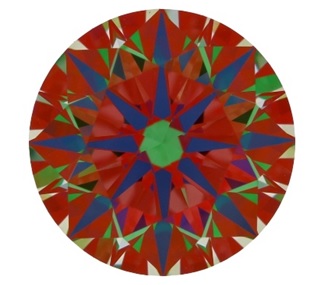
This Brian Gavin signature princess is a fine example of an ideal diamond you can use as a benchmark when comparing other princess cuts. The ASET image shows areas of red which indicate intense light return and is highly desired since it translates into a bright and sparkly diamond. It has optics that represents the top 0.1% of all the polished princess cuts in the market.
On the other hand, WhiteFlash has the biggest in-stock inventory of ideal cut princess diamonds of any retailer anywhere and they have similar standards to BGD. Their princess cut diamonds are carefully vetted for clarity issues like dangerous feathers in corners and clarity characteristics that diminish light performance. So, if you are looking for the best of the best and want a peace of mind with your purchase, both of them are great places to buy your ring from!
2) My own preferences would be G color or better and SI1 clarity or better. The bottomline is, I expect a diamond to be eyeclean if I am making the purchase myself. The majority of readers like you expect eyecleanliness as well. As for color, I tend to value it a little more than the readers of the blog. Being Asian, I do want to see icy white diamonds on engagement rings and proposal rings.
3) All the diamonds you picked are among the better ones in the world of princess shape diamonds. So, you are obviously on the right track and did your due diligence well. That said, I’m anal and picky when it comes to cut quality. Among all the options you shortlisted, the James Allen diamond is the worse of the lot. I have preferences for these diamonds:
– https://www.briangavindiamonds.com/diamonds/diamond-details/0.730-g-si1-princess-diamond-ags-104080595013
– https://www.whiteflash.com/loose-diamonds/princess-cut-loose-diamond-3907540.htm
– https://www.whiteflash.com/loose-diamonds/princess-cut-loose-diamond-3695589.htm
Is there a 6-prong option for a square 1-carat princess cut diamond? My daughter-in-law recently knocked the diamond out of her 4-prong setting and is now scared to replace it with another 4-prong fearing that it might happen again. (Thank goodness she found the stone!) Do you have any suggestions on the strongest setting for a 1-carat princess cut? Thanks so much!
Nope. 6 prongs for princess cut rings are extremely unusual. And even if you do find one, it doesn’t solve the root problem. If you are not careful, no amount of prongs or protection will help prevent this from happening again. If you are going for the “best” protection, then get a bezel setting.
Again, I will reiterate that you need to remind her to be careful of her ring while wearing it. That offers more protection than anything else.